Read more on "Everybody Needs A Homeland – Christian Gampert on ISRADRAMA 2025" »
Christian Gampert
Frankfurter Allgemeine Zeitung- 7.4.2026
The “Isradrama” Festival in Tel Aviv immerses us in the traumatization of Israeli society after October 7 yet still leaves room for self-criticism, women’s emancipation, and even reincarnation…
Dim lighting. A thin figure in a nightgown, with disheveled hair, gropes through the nearly dark space and bumps into hanging metal rods. The vibrating sounds escalate electronically into a warlike inferno. The figure grows frightened and blows into a strange long-necked trumpet that sounds like a siren. Air raid alarm? The figure goes to bed and pulls the blanket over its head. But the bed is actually a wardrobe converted into a coffin, into which the figure will soon fall. It is already lying in its grave.
Thus begins actor Losha Gavrielov’s solo piece, which, despite everything, is called “Light” – at some point there will be light in these dark times. Over the course of the performance, Gavrielov transforms from a frightened civilian into a soldier who must armor himself with scattered car fenders. And yet still chases butterflies. Gavrielov, who runs the “Davai” Theater (“Come on!”) on the edge of Jaffa together with his equally eccentric colleagues Fyodor Makarov and Vitaly Azarin, is a Beckett-like figure. He does not speak a single word throughout the performance. Although he originally conceived the piece in response to Putin’s invasion of Ukraine, it is now, in Tel Aviv, inevitably read in the context of the wars with Gaza, Lebanon, and Iran.
The audiences of the “Isradrama” festival who were able to visit these three virtuoso clowns – immigrants from Russia – in Jaffa were fortunate: without the ceasefire brought about under pressure from Donald Trump, the festival could not have taken place. As absurd as it may sound, “suddenly peace broke out,” said playwright-actress and festival director Hadar Galron in her opening speech – and thus nearly 60 participants were actually able to attend. For Galron, a huge relief: canceling live performances once again and moving the festival online, as in previous years, would have further isolated the Israeli theater scene.
And yet: October 7, the Gaza war, pro-Palestinian protests, especially in Europe and the U.S. – all of this formed the backdrop of “Isradrama.” No theater professionals came from boycott-inclined Western European countries influenced by BDS; Germany, with six participants, was the exception. There were also no guests from Latin America or Turkey, who had regularly attended before COVID. Instead, there were Eastern Europeans, Russians (!), Asians, and a few Canadians. The remarkably high number of Chinese participants shows that Israeli cultural policy is also seeking dialogue with ideologically very different countries.
“Isradrama” aims to present the latest productions from Israeli stages to theater professionals from around the world – and ideally send them on tour. That this year’s program committee primarily selected works from the independent scene marks a radical paradigm shift – one unlikely to please the major repertory theaters in Tel Aviv and Haifa. The renowned Cameri Theater was not represented at all.
At the former trade union theater Beit Lessin, one could see a mother-daughter conflict by the seasoned playwright Hillel Mittelpunkt, who also directed “Mother.” With lesbian love, protests against judicial reform, and an emigrated left-wing rock singer (as the mother), it aims to be topical – but theatrically it remains quite conventional. At the national theater Habima, another family conflict unfolds: an existentially charged father-son duel over academic merit. Moshe Kepten’s adaptation of the film “Footnote” is distinctly Israeli – two Talmud scholars – and portrays the emotional wounds of academic rivalry within a fragile family. Yet again: under-challenged actors, dutiful direction.
The madness of the “Davai” clowns perhaps reflects Israeli society more accurately – at the end of their performance, plastic toy soldiers were distributed for the audience to bandage. The traumas of October 7 are primarily being processed in the independent scene.
Outstanding among these is “A Place to Live” by the Otef Ha’Negev Theater – performed in Kibbutz Urim near the Gaza Strip; the Nova festival grounds are close by. Five individuals tell their life stories – and almost casually come to “the day of days” that changed everything. The audience is confronted with eyewitness accounts of October 7 and its aftermath, which left many kibbutz residents homeless. Suitcases are packed and placed among the audience; very young and very old actors ponder how to go on and whether it is possible to start over. Video projections show them relocated by the government to luxurious hotels far away. But they all remain in their rooms; no one uses the swimming pool. The basic sense of security – of having a home – cannot be restored through luxury.
October 7 is also central to Roee Joseph’s work. The very young playwright and actor was stationed at the “Shura” military base after the attack and tasked – or perhaps burdened – with identifying mutilated bodies. As a form of self-protection and therapy, he began to write about it. In the play, he constantly reflects on this writing process, the relationships among soldiers, and the events of October 7 – and grapples with the unimaginable condition of the bodies he encountered. In the performance at the Tmuna Theater, inflated white plastic bags are moved around as stand-ins for the dead. While initially powerful, this ritualized staging solution becomes increasingly awkward, revealing the play’s central problem: the experience has overwhelmed the author to such an extent that he has not yet found a dramaturgical form. He repeatedly asks how one can represent what happened. Perhaps the answer is simple: one cannot. Or perhaps only much later, with distance.
The traumatization of Israeli society – directly or indirectly – is the festival’s central theme. Panels presented various, not always convincing approaches: survivors of the Nova rave performing as a chorus; actresses framing time spent in bomb shelters as an adventure for their children. Everyone is psychologically wounded; everyone seeks therapy.
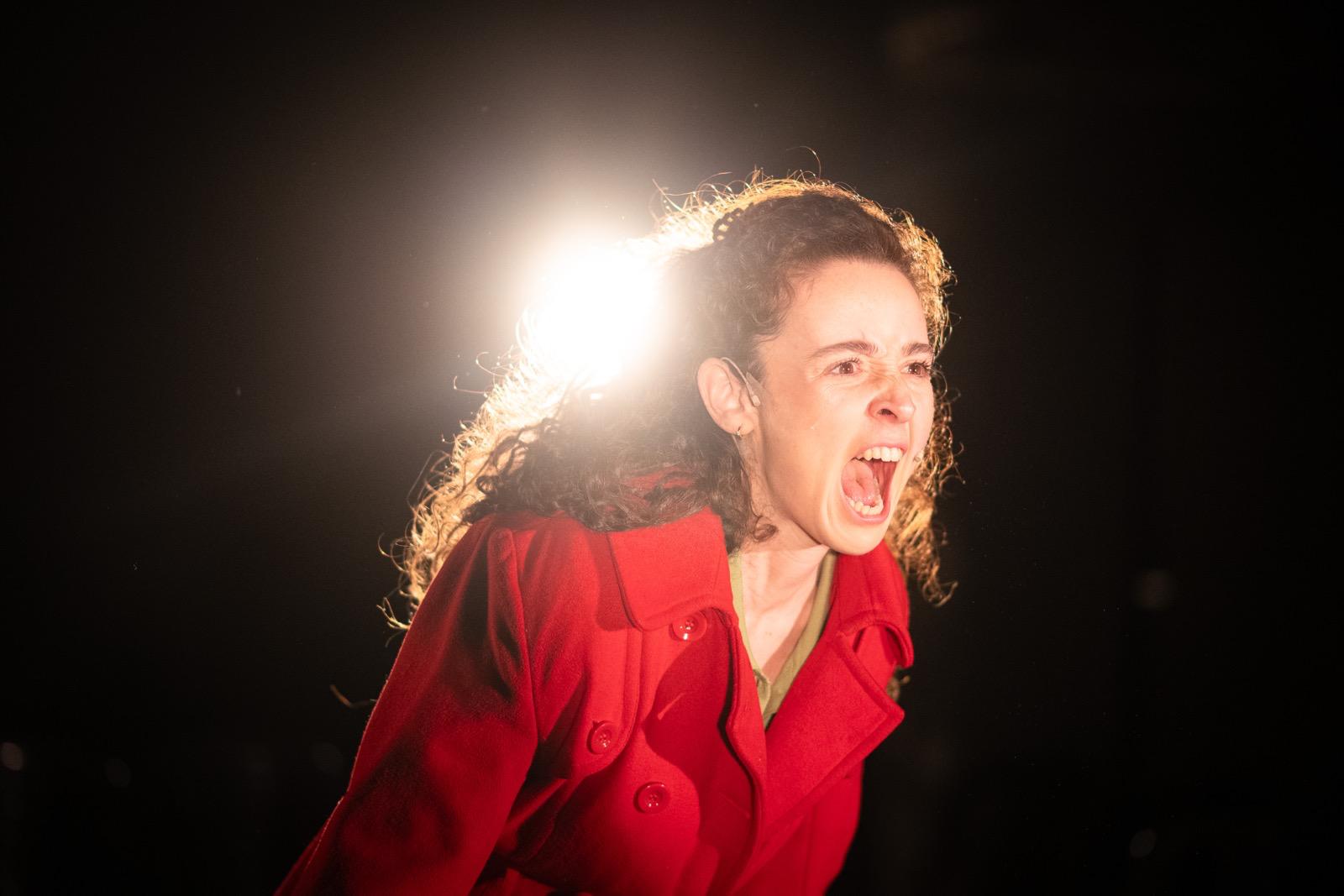
The most compelling work on this theme is “Everything Remains Alive” by (female) director Yarden Gilboa . It deals with post-traumatic stress disorder in a soldier who suffered trauma during his military service in Gaza in 2004, when he had to recover body parts of comrades. His wife, actress Dana Keila, recounts his transformation – and her struggle to maintain a family life amid his despair and unpredictability. The husband is played by an actor, but eventually the real traumatized man appears on stage. This, too, is Israeli reality: every family has its dead and wounded. Dana Keila’s powerful stage presence turns this into a reenactment of her life’s struggle – and at times, it is very difficult to watch.
Israeli theater artists have not forgotten the Palestinian side. In almost every discussion, one hears empathy for Gaza’s population and criticism of the Israeli government. Some hope the ceasefire will hold; the majority, however, believe Hamas will not surrender and that the situation will escalate into another conflict with Iran. The cultural sector will have to contend with this as well.
That women are increasingly asserting themselves on Israeli stages – including as directors – might not be obvious in Tel Aviv’s state theaters. But the festival’s focus on the independent scene highlights female voices more strongly. Hana Vazana-Grunwald, for example, directed “That Is to Say” (based on a novel by Sami Berdugo) at the Arab-Hebrew Theatre in Jaffa. An Israeli-born intellectual tries to teach his elderly mother, who immigrated from Morocco, the Hebrew alphabet – but she neither can nor wants to learn. Instead, she wants to tell him about her life in the diaspora. Mizrahi Jews, especially those from North Africa, still have little political influence in Israel. Actress Pazit Yaron Minkowski turns the mother into a moving portrait of experienced, resigned wisdom, accompanied by almost psychedelic Maghrebi music.
Aya Kaplan has recently become artistic director of the Be’er Sheva Municipal Theater and she puts women’s issues on frontstage. In her play “Permitted to Any Man,” an unhappily married woman seeks a divorce from her Orthodox husband – a process still fraught with obstacles and humiliations in Israel, including appearances before a rabbinical court if the husband refuses consent. Seen as a filmed production, Kaplan stages the conflict as a psychological war, showing a degree of empathy even toward the overwhelmed husband. Other productions from the theater explore family structures in which a husband continues to control a woman’s life even after death. In “Till Death Unites Us,” a deceased husband leaves his wife a list of three potential successors – ostensibly a comedy, but ultimately a critique of patriarchy.
Many contradictions coexist within Israeli society and its theater. Hospital clowns comfort survivors of October 7 and incorporate filmed fragments into performances. Puppets serve as mediators for difficult conversations. The legendary director Yossi Yizraeli, now 86, presented excerpts from his staging of Kafka’s “Metamorphosis” – a brief moment when the sun of world theater seemed to shine. The concept is simple: Gregor Samsa cannot or will not get up – for good reason. But the acting is extraordinary.
Finally, director Itay Tiran led audiences through four hundred years of Jewish history at the Gesher Theater. “Souls,” a sweeping work by Roy Chen, uses reincarnation to explore shifting Jewish identities – from Russia to Venice to Israel – touching on Purim plays, carnival, cross-dressing, sex, and contemporary Tel Aviv melancholy. The wandering Jew reappears – even after October 7, forced to pack again in a ravaged kibbutz. He lives here too, as an unspoken central figure of the festival. And he needs a home.
Last year, during the Gaza war, Shimrit Ron of the Hanoch Levin Institute for Israeli Drama organized a kind of emergency festival – only five participants attended. This year, “Isradrama” was almost normal: no rocket alarms, a wide diversity of participants, themes, and forms. But perhaps this is only a pause for breath.
One day after the festival ended, playwright Hadar Galron premiered a sharp satirical cabaret as an actress too: “The Final Final Solution”. Iran and Hamas have long held such a solution on offer. In Europe, such proposals are taken somewhat less seriously than in Tel Aviv- where the weather is usually bright, but the future remains bleak.
Isradrama 2025 Bericht von Christian Gampert in der FAZ vom 7.April. 2026 (1)